Wednesday, November 25, 2015

Fooling Around

Fool's Gold, a way for ignorance
to breed happiness if believed
to be gold
Daisy once said, "I hope she'll be a fool-that's the best thing a girl can be in this world..." (Fitzgerald 21). How inexplicably sad. As a child or even a teenager, you hear people say "ignorance is bliss!" I think the worst part about growing up is realizing that it's true.

How wonderful it must feel to be a fool! To be unaware of the sadness that surrounds you. To be blissful in your ignorance. Once you see the world for the way that it is-flawed-you can never go back to being the fool that you once were. That's why Daisy explains that it is best for her daughter to be a fool. Foolish people believe in love at first sight, and money, and eternal happiness, and things that make life seem better than it is.

A Fool, whose job it is
to be happy
In essence, we all are foolish in some way. Anything that really draws away from the truth of the world is an act of foolishness. Sitcoms, comedies, dramas, entertainment in general. A way to escape the world and submerge ourselves in make believe. It really is foolish.

Not to mention the incessant need to own things and use things and throw them away. The way that people turn a blind eye to things they would rather not acknowledge is another way of acting foolish.

Fools believe in perpetual good. They would believe lies meant to make them feel better such as, "I'm not cheating on you, I love you!" or "No, nothing bad happened today." Completely wrapped up in their own world, they would be able to cocoon themselves in some strange version of reality, but perhaps that is what makes them happy.

a (cute) wise old owl
I guess the really horrible thing is to be wise. To be wise is to have lived through pain. Yes, the wise have learned from it, but it begs the question, wouldn't it be better to not have lived through the pain at all?

Lyrics of the week: "Wise men say only fools rush in, but I can't help falling in love with you" from Can't Help Falling In Love by Elvis.

Because love at first sight is probably the most foolish of all kind.

Sunday, November 22, 2015

The Guiltiest Hand

a cute little stick man carrying his not
so cute guilt
Remember how in elementary and middle school, when we were learning about bullying, they said if you didn't stand up to the bully you were just as bad as one? As any normally-functioning human, it was because you had a sense of guilt. Did you really want to be the reason a poor kid gets beat up?

They say that guilt is one of the heaviest things a soul can carry. That it stays with you always. Voltaire once said, "Every man is guilty of the good he did not do."


Even I still catch myself feeling guilty about things that nobody probably remembers or cares about. Like not inviting some friends to a party, saying something that stung in an argument, or even that one time I made my brother cry in Chicago when we were little. Guilt is like this little book you carry with you, adding new names and events to it each day. But the book never runs out of pages. It just gets thicker and heavier and you still have to carry it every day.
the cause of my Chicago-based guilt

To me, I think that is what The Bluest Eye came from. Although yes, I know it is a fictional story, Morrison is definitely living with some kind of guilt about not changing the world for the better. "It's too late. At least on the edge of my town... It's much, much, much too late" (Morrison 206).

If we are guilty of the good we have not done, then there is a lot to be guilty about. Look at the world around us. It's being torn apart by terrorist attacks, natural disasters, and just mean people in general. So with this book, Morrison forces us to take a look at ourselves. Is it too late? Can we still right our wrongs? Or must we carry this guilt forever?

Looking back on the novel, I think Morrison used it as a medium to not only ease her sense of guilt, but to bring us into touch with our own.

Lyrics of the week: "Do I divide and fall apart? Cause my bright is too slight to hold back all my dark... And at the gates does Thomas ask to see my hands?" from Jesus Christ by Brand New.

Friday, November 13, 2015

Race and Religion

I write this with heavy eyes, and a heavy heart. After watching the news today I was completely disappointed in the world. The Paris terrorist attacks were nothing like the way that I wanted my Friday night to go. But after a bit of a personal discussion (the details will not be revealed) with my new BFF who gets weirdly philosophical past 11:30 (his bedtime), I came to see a connection between the conflict of race in The Bluest Eye and religion in India.

Now I would go back and just discuss the effect of racism in the past but I kind of already did that. (See here if you missed it and are slightly curious). So I decided to take it back to my homeland. Back when those Brits ruled us over for spices I cannot seem to find in their food (sorry, but seriously I went to Scotland and the only thing on their fish was salt). (I just realized salt can be used as a pun and now I'm laughing alone in my room at 2 a.m.). Anyway, so once India gained its independence, the British-apparently knowing best how to govern people-decided to split the country up based on religion.

A Train From Punjab During
The Partition
See that would have been all fine and dandy, if it weren't for the fact that IT RUINED INDIA. Before the Par
tition, Muslims and Hindus may have gotten into a few fights, but it is nothing compared to what has happened since August of 1947. Every Hindu living in now-Pakistan was required by law to move to current day India, and vice versa. As is imaginable, this was met with some resistance and anger, but the anger lives on today. The same disgust I feel with the racism in Toni Morrison's novel is what I feel when I think about the divide between Hindus and Muslims. Each side carries its own stories, however I can only represent those of a Hindu's.

Both of my grandparents were born into wealthy families, but that was before they were forced to move. In fear of being killed, they left everything behind and travelled to India. Here, they were poor. They had nothing. And when my father and aunt were born, they could only afford to live in a small shack that was meant as a servant's quarters. In Pakistan, Muslims would sometimes find Hindus and kill them. The same went for Hindus in India, they killed Muslims out of pure... (I cannot find a word to justify this violence, because no justification exists.)

In some instances, there was only a little bit of road between the two paths in the Partition. People crossed these paths only to kill.

The Gandhi Movie
There was a great man living during the Partition, his name may sound familiar. Gandhi? Have you heard of him? Well whether you have or haven't I would say you should watch the British-made film "Gandhi" because it makes even the strongest men in my family cry. Here's a clip. (Fun fact: my grandma met Gandhi on his salt march!)

The divide between Muslims and Hindus still survives to this day. Sometimes people are burned alive for their religion, or shunned, or even considered as off-limits to date or marry. It seems quite like the racism that is present in Morrison's novel. The effects of it last to the present, as do the effects of the Partition. In both instances, violence is always apparent. Whether it be the beating of slaves, or the murder of children in India, there is no excuse for this blackness on the history books of the world.
A Riot During The Partition

Both the racism and the divides between Muslims and Hindus have both been carried to America. And here, if you look closely, you will find them "festering" (Morrison 34) in a wound that should have been disinfected long ago.

I, myself, cannot understand why people can't just get along. I know it is harder than it seems, but it is the one thing that I want most in this world. At least I wish we could get over race and religion, which would probably solve almost every problem in the world. Race and religion do not determine a person's character.

This probably should be a lot more emotional, but for now I am tired and thinking about all of the bad parts of the world are making my soul feel heavy.

"How are we going to change the world if all we do is distance ourselves more?" -Amun Mehta, texted at 12:03 a.m. (That's right, the aforementioned new BFF. See Ms. Valentino? I don't hate him! We get along!)

Lyrics of the week: "So may the sunrise bring hope where it once was forgotten... mother I lost it, all of the fear of the Lord I was given" from Upward Over the Mountain by Iron & Wine.

Because all of the goodness instilled by the Lord was lost in both of these atrocious cycles of hatred. And may there be a sunrise where it is all gone.


Sunday, November 8, 2015

Beauty is The Eyes of The Powerful

Blue(ish) vs. Brown eyes
The idea of beauty is different everywhere, and can even change over time, but the general concept of beautiful and ugly remain set in stone for the most part. "All things in her are flux and anticipation. But her blackness is static and dread" (Morrison 47).

Beauty is reflective of those that are in power. In the novel, white beauty is because of white power. This is true of many different situations. During times of racism and opposition to Civil Rights, those in power were those with European features. Hence the preference of white skin to black skin, blue eyes to brown eyes, and
dirty to clean.

an actual picture I took on
my last trip to India
Right now, I'm watching an Indian movie and all I can think about is the similarity. In India, they literally market products to make skin look whiter. Everybody wants that same kind of beauty. So much so, that people even use only light skinned people in advertisements, especially those that deal with something such as a matrimonial.
relationship goals!!!

The fact that beauty is a social construct based on power presents itself in many cases. As mentioned before, America and India. Both which had European ideals in power, India with the British Rule. Not only this, but in times such as with war, the "ideal woman" would probably be considered as a little bit fat right now. This is because during war rations, those in power could still eat, were ric
Marilyn
h enough to still eat, and so had bigger waists. Perhaps this was why Marilyn Monroe was revered with hips of 35 inches while Taylor Swift has hips of 33.

Mauritania is such a poor country that their people send their daughter to fat camp. The more they eat, they better chance they have of getting married. Food is scarce so fat is good. And not only fat, but obesity. Read about it here.

Beauty is different in a lot of geographical areas, but it always comes from those in power.


Lyrics of the week: "Cause I'd be lost forever if you slipped away, blue eyes you're the reason for my change" from Blue Eyes by Timmy Curran.

Sunday, November 1, 2015

Barbies Are Worse Than Junior Year

Read my title. Read it again. Good. Now read it again.


When I was little, Barbies were basically my life. My older cousin had a small laundry basket FULL of them and once she outgrew them, they became mine. Of course, I had to add to the collection. Obsessions are fleeting but intense for me. I added more and more to my Barbie collection and played
with them whenever I was bored. Soon after that, I moved on to Polly Pockets and the rest of the kinds of toys that little girls are obsessed with.

Each toy in itself was different. Perhaps the eyes were slanted at another angle, the nose just a little bit sharper, or the skin a little bit darker. But looking back at it now, they all had the same underlying tone: beauty.

Beauty is something that I have struggled with for many years.

Just as I become comfortable in my own skin, something comes along to change my views. I always want my legs to be a little bit longer or my stomach a little bit flatter. I always find something to
dislike about myself. It sounds twisted, but I'm not alone. In fact (as we learned in psych) a study had once shown that 99% of women had something about themselves that they would want to change.

If Barbie were real
That's disgusting. It's just like in The Bluest Eyes. Toni Morrison says that beauty is "something one could do" (11.) There is no concrete definition for beauty, perhaps because it is different from person to person, but also because it is-in my opinion-unachievable.

Barbie's standards are literally unachievable. She sets this standard for little girls of a kind of beauty that is too hard to meet. She sets children up for failure and low self esteem. Look at this post of the most beautiful women. Most of them look like real life Barbies. Even if we don't carry a picture of a Barbie around as inspiration, the same kind of looks that she embodies show up in the people that we idolize.

That is why Barbie is worse than junior year. Junior year, no offense. but you suck. Barbie suck more. Junior year is something that you need to go through. But me? I could have gone through life fine if I wasn't kind of conditioned by society to strive to be a variation of Barbie.

Barbie is so useless. On top of necessary stress (most of which can even be argued against as unnecessary), she adds stress to the fact that everyone has to strive to become someone else's version of beautiful. This version of someone else has even been so deeply ingrained in everyone that they believe it to be their own sense of beauty.

A "Real" Barbie
Where is the Barbie with a layer of fat on her stomach? Where is the Barbie with the hairy arms? Where is the Barbie with her thighs touching? Where is the Barbie that is supposed to make me feel good about myself? Because all I see is something that will only cause me to pick apart myself.

Everyone and everything has beauty in them, but we're all being controlled by a 11.5 inches of cheap plastic.

Lyrics of the week: "I'm a Barbie girl, in the Barbie world" from Barbie Girl by Aqua. 

Saturday, October 24, 2015

The Kids Aren't Alright

So... It's Maus week 2. I feel like there may be a general sense of dismay due to the fact that everyone has to come up with ANOTHER Holocaust-based blog post. But contrary to what I am pretending the popular belief is, I am just teeming with opinion (hard to believe, I know).

childhood comics = gold
So the thing is that earlier this week we talked about why comics were the appropriate medium for Spiegelman and all that jazz. (...All that jazz? Did I really just say that? What's wrong with me? The sleep deprivation must be getting to me...) My very good friend, Shreya Subramanian, even said that it was to help readers distance themselves from the horror of the Holocaust. She reasoned that comics are associated with the innocence and happiness of childhood. While I agree with her reasoning, it got me thinking (rather, rethinking). What if Art Spiegelman didn't mean to distance readers from the horror, but actually immerse them in it? The entire book is kind of a detailing his immense struggle to understand the concept of the Holocaust, so maybe he is trying to put the readers in that same situation.
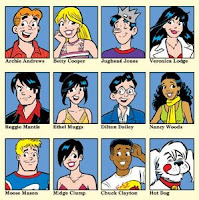
Archie Andrews and his friends
For me, comics are associated with childhood and happiness and innocence all of the way. I grew up
with 2 older cousins always by my side, both extremely infatuated with the adventures of Archie Andrews and his friends. Jughead, Hotdog, Moose, Midge, Veronica, Betty, Reggie, and the rest of the gang. My cousins had a huge bookcase just full of Archie comics waiting for my little fingers to grab them and dive in. In fact, Archies were such a huge part of my childhood that when I'm feeling too stressed to function, I pick up an Archies and transport myself to Riverdale. I've always considered books to be something magical, waiting to take me away to some place new.

So that's what my mind went to. The fact that books took it somewhere else. The entire time I was reading Maus I was trying to picture myself walking the streets of Poland with Vladek. But I just couldn't do it. Because it was a comic, supposed to be childish and pleasant. It was so hard to imagine myself younger (when I used to read Archies so often I talked about them like I lived them) reading this secondhand account of a horrible history. Then my mind got going... and that is when this idea took place in my head.

What if the reason that Art Spiegelman decided to write Maus as a comic was to remind readers of childhood? It would remind them fully, constantly, perpetually, that the children of the Holocaust had no childhood. The innocence that the general public associated with comics was gone. The children of the Holocaust had their innocence stolen. Blackened even... like the ink on the pages. Throughout the story, the mice are shown as shaded in when they connect to their horrible and scarring past. The borders that the readers touch, the only part of the book that they feel (literally) is that white innocence. The entirety of the piece is to emphasize that we will never connect to the same amount of pain that the victims of the Holocaust did. We, the distanced audience, are reading this story on a medium that takes us back to childhood, while those children in the story never even had one.

It's 2 am and my brain is working quickly so try to keep up.

In Tae Kwon Do, we learn the symbols of each belt color. White symbolizes purity and innocence, which is what Art and the audience really embody. Unable to go back to the past, they live an innocent and sheltered life. Black, the color of the ink and the history, symbolizes maturity. The only thing the readers have is their innocence, and the one thing the mice in the story have is that maturity that was forced upon them.

the Criminal Minds cast
It's quite like the kind of feeling I get when I watch Criminal Minds and there is a kid involved. It's the best TV show. If you don't watch it I would highly recommend it, unless you have a problem with violence. A lot of the episodes in one way or another incorporate children. I think most people end the show feeling happy. Yay! They caught the bad guy! He's going to jail! They did it! They made the world a better place! But not me. I'm always stuck at the end. What happened to those children? Did the trauma of their abduction impact them later on in life? Did the knowledge that their father or mother was a murderer push them to act in violent ways too? Did they develop emotional problems? Psychological ones? Could they sleep at night? Were they always afraid of repeating their trauma? Just like Art Spiegelman's mice, the children in the show lose their innocence at a young age. They no longer regard the world as a perpetually happy place.

These questions and many more run through my mind almost every single time there is a child on the TV show. Where is their innocence? What about the Jewish kids under Hitler? Where is their innocence? Even little Richieu was victim to this horror. "He got killed... he was only five or six" (Spiegelman 15). Not only did the Holocaust steal his innocence, happiness, and childhood-it stole his life too.

Maybe this makes no sense, maybe this makes a lot of sense, but when I look at the comic, all I can think about is childhood. And all I can think about is how the children in the story and in real life never had one.

Lyrics of the week: "If you're still bleeding, you're the lucky ones. Cause most of our feelings, they are dead, and they are gone... well I've lost it all, I'm just a silhouette. I'm a lifeless face you'll soon forget." from Youth by Daughter.

Sunday, October 18, 2015

The Past Is Tomorrow

In Kung Fu Panda, Master Oogway spits some truth when he says "Yesterday is history, tomorrow is a mystery, but today is a gift. That's why they call it a present." My mom liked that quote so much that she dramatically reenacts it if my brother or I appear to be stressed about "a mystery" as it is called. She tells us that today is a gift that we will only experience once. Time after time growing up I've heard someone tell me "Don't worry about it! The past is in the past!" or "It's water under the bridge!" or "Let sleeping dogs lie!" or "Let bygones bygones!" In fact, just last week I used those words in my blog post. But is the past really in the past? It seems to me like people carry it everywhere they go. Isn't the simple act of learning just carrying the past with you? You are your past. Everything you do in the future is determined by the past.

page 115 - Volume 2
Everybody knows about PTSD... which is kind of like carrying your past with you (to the extreme). Only everybody carries their past don't they? It is intertwined with our future. You cannot have one without the other. This summer my friends and I were driving up north, discussing the issue of the past and present (lol don't judge us for our choice of entertainment), and we wondered if there was such a thing as free will. Isn't every choice we make predetermined by our past? For example, lets pretend I visit a mall one day and then revisit a week after. There are two stores I can go to, but I only have time to visit one. Last week, store A had a nice sales associate and store B had a sales associate that muttered some choice words under her breath as she glared and charged my debit card. It would make sense for me to be inclined to visit store A again instead of store B. Right there, my past influenced my future. No true free will, just carrying the past with me.

In volume 2, page 115 of Maus, photographs of Vladek's past cover the panels. If you look towards the bottom, there is no page number. All of the photographs and Vladek's emotions make me feel as if this page was meant to symbolize his past. However... it begs the question: what page is it? That's the funny thing. There is no one page that symbolizes Vladek's past. It is everywhere in the book. Similar to the fact that Vladek's past is not confined to a single page, nobody's past is confined to a certain part of their life. The past is everywhere around us. It is (literally) our past, present, and future.

Vladek's exposure to extreme trauma amplified his connection to his past, but in essence, he is like the end of a spectrum for the general population. People may not realize it, but they can relate to him more than they know. Vladek's past is with him constantly in his present, similarly we all carry our past to our present. Otherwise we would basically be acting like newborn babies all day. If this is true, the past and the present blend together. It can be difficult to pinpoint exactly where your past and present are. Can you tell where your past and present begin and end?


Lyrics of the week: "It's just a story though, is it a story though? I can't tell if it happened cause it feels impossible. Don't know whether it was real or a dream, imagination playing tricks on me." from Murakami by Made in Heights. I can't tell whether my past is my present, my future, or both.